


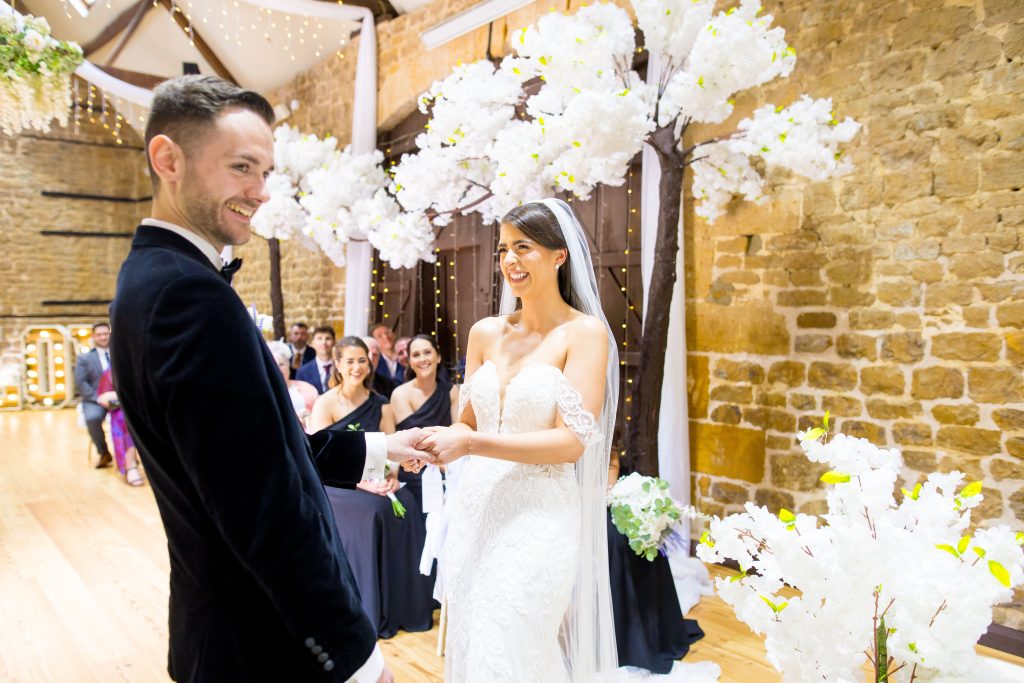
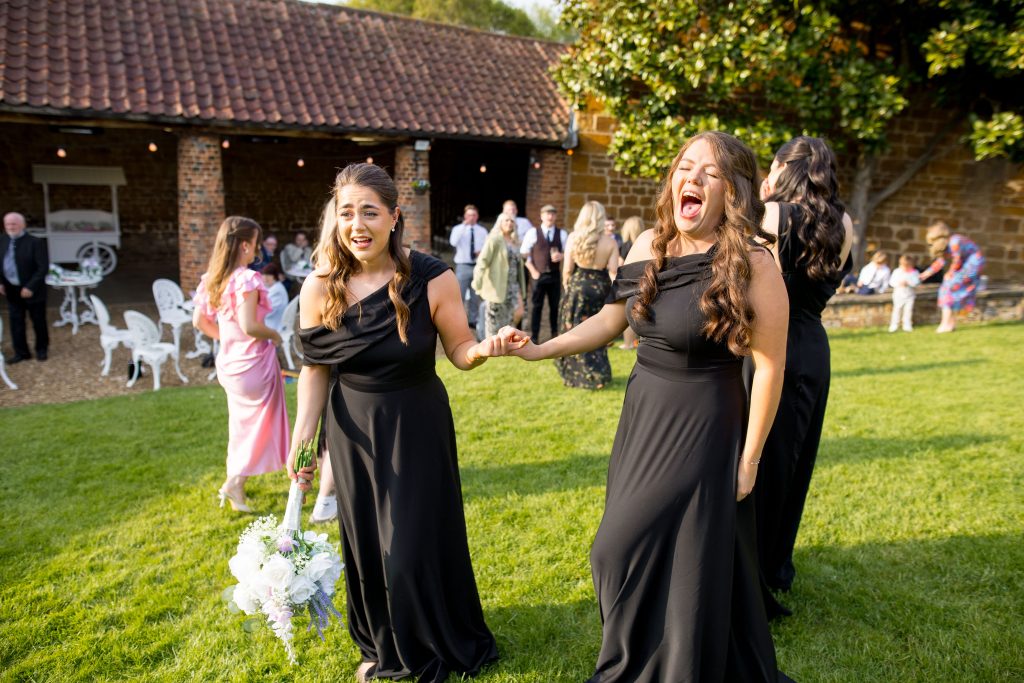
As you can hopefully tell from the photos, this was a day full of fun and laughter from start to finish.
I arrived at Lauras parents house for prep with bridesmaids and hair & makeup ladies already fully underway. Prosecco opened and music on, the morning carried on in the same vein as it started. The odd tear here and there from an emotional mother of the bride but other than that, all smiles and giggles.
After a vintage car ride over the The Barns, Kieran was waiting for his bride to be at the top of the aisle. More tears flowed – from Kieran this time – as Laura made her way towards her future husband before tying the knot and heading back outside for the confetti run.
The saxophonist provided a beautiful musical backdrop to the day and even the sunshine came out to play. Speeches were had before dinner before the fun of the bouquet toss and we moved on into the night and onto the dance floor. A colourful and vibrant first dance was had before a few shots outside with a stunning sunset backdrop to finish the day perfectly.









Suppliers
Venue: The Barns at Hansbury Hill
Hair: Love Laura Hair Design
Makeup: Lucy Whitfield Makeup
Caterers: Impressions Catering
Band: California Waiting
History of the Barns at Hunsbury Hill
The Barns at Hunsbury Hill form part of a rare and important 18th-century model farm, built around 1770 on land that had been part of Hardingstone parish’s medieval common fields since at least 1220. The site represents an early and influential example of planned agricultural improvement during the Enlightenment period.
Origins and Construction
The farm was created by Edward Bouverie of Delapré, who purchased Delapré Abbey and the manor of Hardingstone in 1764. Shortly after acquiring the estate, Bouverie became one of the pioneers of the early enclosure movement in Northamptonshire, enclosing the former open fields around 1765. Enclosure allowed more efficient farming at a time when agriculture was under pressure to feed a rapidly growing population.
To announce his arrival as lord of the manor and to take full advantage of enclosure, Bouverie commissioned an impressive new model farm on Hunsbury Hill by about 1770. Unlike earlier farms that developed gradually, this farm was fully designed and built as a single, integrated complex. It included a large farmhouse, two substantial barns (now known as the High Barn and Low Barn). Animal sheds and small ‘hovels’, all arranged around a distinctive octagonal courtyard.
Design and Agricultural Purpose
The octagonal courtyard layout was highly unusual for its time and reflected contemporary Hanoverian and Enlightenment ideas that combined beauty with utility. Each building was carefully positioned for efficiency, ease of movement, and improved working practices. The two main barns were originally intended for corn and hay, suggesting that the farm began as a mixed farming enterprise.
Before 1810, two long feeding sheds were added. This indicates a shift in focus towards fattening livestock for sale at the nearby Northampton market. This change likely reflected both improving transport links and the demands of Northampton’s expanding population.
Tenancy and Survival
For roughly the first 100 years of its existence, the farm was tenanted by successive members of the Shaw family. This long and stable tenancy may explain why much of the original farmstead survived with relatively limited alteration. While some ancillary buildings were modified or replaced as farming methods evolved, the overall layout and principal structures remained intact.
Decline of Farming and Industrial Impact
In the late 1870s, farming on Hunsbury Hill ceased temporarily due to widespread ironstone extraction across the site. Although the land was reinstated afterwards, the disturbance left the soil unsuitable for arable farming. When agriculture resumed in the early 20th century, the farm was used mainly for livestock, particularly sheep, rather than crops.
Modern Use and Preservation
Today, the barns are Grade II listed, recognising their architectural and historic significance as a surviving 18th-century model farm. The site is owned by Northamptonshire ACRE, a charity dedicated to supporting rural communities. The barns have been carefully restored and adapted for use as a wedding and event venue. Retaining key historic features such as exposed beams, stonework and the dramatic internal spaces.
Income generated from events helps fund ACRE’s work in community development, village planning, and reducing rural isolation.
History of Northampton
Northampton is a historic market town in Northamptonshire, England, strategically located on the River Nene. With origins stretching back thousands of years, the town has played a key role in national history, from Iron Age settlement to royal stronghold, industrial centre, and modern urban hub.
Early Northampton: Prehistoric, Roman and Saxon
The Northampton area has evidence of prehistoric activity, most notably at Hunsbury Hill, site of a major Iron Age hillfort. During the Roman period, nearby settlements developed at Duston and along Watling Street, one of Roman Britain’s most important roads. The River Nene provided vital transport links.
In the Saxon period, Northampton emerged as Hamtun, a fortified burh within the Kingdom of Mercia. In 921 it was captured by Edward the Elder, bringing it firmly into the Kingdom of England.
Norman and Medieval Northampton
After the Norman Conquest, Northampton became an important administrative and military centre. Northampton Castle, built beside the River Nene, served as a royal residence and hosted medieval parliaments. The town is recorded in the Domesday Book of 1086, highlighting its economic importance.
By the 12th and 13th centuries, Northampton was one of England’s largest towns, thriving on markets, trade, and cloth production. Religious houses included Delapré Abbey, St James’ Abbey, St Andrew’s Priory, and the Church of the Holy Sepulchre, one of only four round churches in England.
Battle, Fire and Civil War
In 1460, the Battle of Northampton was fought near Delapré Abbey during the Wars of the Roses, resulting in the capture of King Henry VI. During the English Civil War, Northampton supported Parliament, and following the conflict Northampton Castle was demolished.
The Great Fire of Northampton in 1675 destroyed much of the medieval town centre. Rebuilding led to wider streets and stone buildings, including the rebuilt All Saints’ Church, supported by King Charles II.
Industrial Northampton and the Shoe Trade
From the 18th century, Northampton became world-famous for shoemaking and boot manufacturing. The industry expanded rapidly in areas such as St James, Kingsley, Semilong and Abington. Renowned firms including Church’s, Tricker’s, Crockett & Jones and Edward Green established Northampton’s global reputation.
Transport improvements, including the Grand Union Canal, railways, and later the M1 motorway, reinforced Northampton’s importance as a manufacturing and distribution centre.
Modern Northampton
During the 19th and 20th centuries, Northampton absorbed surrounding villages such as Abington, Kingsthorpe, Duston, Far Cotton and Hardingstone. Designated a New Town in 1968, major expansion took place in areas including Weston Favell and the Eastern District.
Today, Northampton combines historic landmarks with modern development. Key sites include Delapré Abbey, Abington Park, Northampton Museum and Art Gallery, the Market Square, and the University of Northampton. With its long and varied history, Northampton remains one of the most historically significant towns in the Midlands.


