

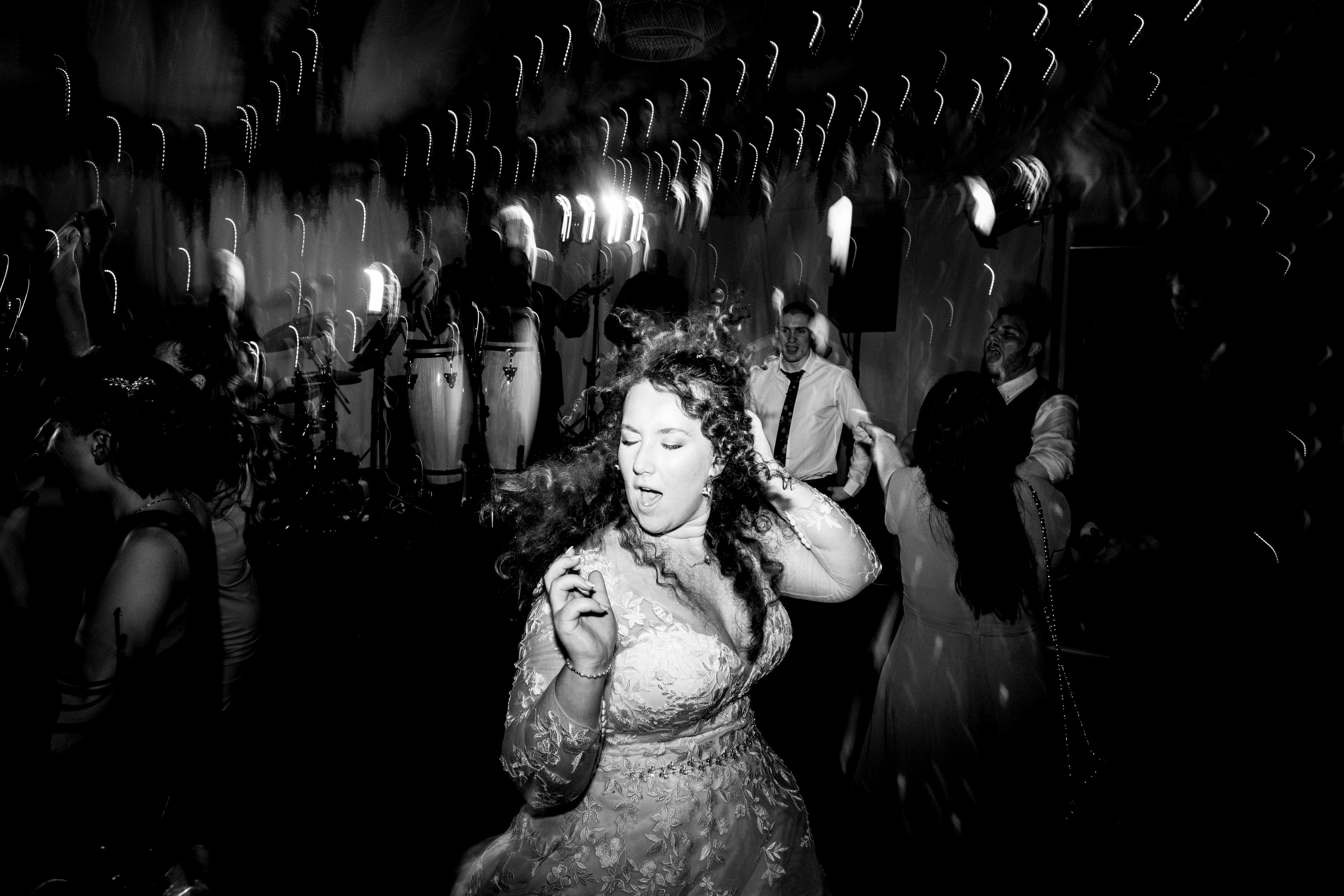
What a lovely day this was! It all started with much Prosecco popping a lots of laughter with Jess and her bridesmaids during the morning prep where finishing touches to makeup and hair were being applied before we moved over to the bridal suit and the ladies got into their finery. Jess, in her wedding dress, looked stunning I think you’ll all agree.
A beautiful service was had in the ceremony barn before we dashed outside to embrace the chilly weather for the confetti run. Back inside and in the warm, we were kept entertained by one of the brides cousins playing the saxophone throughout the drinks reception.
Once dinner had been had, it was speech time and these were finished off by an impromptu song from the multi talented cousin, who entertained everyone with an excellent persinally written song for the happy couple.
The first dance was had in the bespoke room and the band then entertained a very enthusiastic crowd on the dance floor for the remainder of the evening. All in all, a lovely day all round!


Suppliers:
Venue: Crockwell Farm
Dress: Wed2Be
Suits: Suited Formal Hire
Hair & Makeup: Frankie Rose Hair and Makeup
Caterers: Ross & Ross Events
Flowers: Green Room Flowers
Band: Bang Tail Feathers
A Brief History of Crockwell Farm
The stone farmhouse at Crockwell dates back to 1720. The surrounding fields have been used for agriculture for centuries, long before the farmhouse was built. The farm has been in the hands of the Harper family for many years, previously known under the Miller and Tustian names. It remained a working farm under tenancy until 1960, when the last tenant farmer departed and the house fell into disrepair.
In 1980, the current owner, Bay, moved into the derelict farmhouse and began farming the land alongside his brother Richard. He gradually restored the farmhouse, and was soon joined by his fiancée, Hermione. The couple celebrated their wedding with a reception in a marquee in the garden.
For the next two decades, Bay and Hermione lived and farmed at Crockwell, managing both arable and pasture fields. The barn now used for weddings was a lambing shed, and the honeymoon cottage – Dryden – served as a stable.
As small-scale farming became increasingly challenging around the turn of the century, Bay began to explore diversification. In a forward-thinking move, he started converting some of the farm buildings into holiday lets and event spaces.
From Farm to Wedding Venue
Crockwell hosted its first wedding in 2002 in what was then the old grain barn – now home to the main marquee. It was a charmingly rustic celebration, complete with a hog roast from a neighbouring farmer and dancing in the barn, which had been cleaned up but retained its rugged charm.
It quickly became clear that Crockwell’s farmhouse, cottages and stone barns offered a uniquely beautiful setting for weddings. Since then, the venue has grown organically, with Bay leading projects including the transformation of the Mews, the creation of a dedicated bar, the installation of the main marquee, and the conversion of a grain store into today’s starlit dancefloor.
Over the years, Crockwell has hosted around 750 weddings. While farm wedding venues are now plentiful, we’re proud to have been one of the pioneers – and we believe, one of the best.
Northamptonshire History
Northamptonshire, often referred to as the “County of Spires and Squires,” is a historic and landlocked county in the East Midlands of England. It is rich in heritage, culture, and historic landmarks. Its county town is Northampton, a settlement that dates back to Roman and Saxon times and gained prominence during the Middle Ages. The town was once a royal seat, boasting Northampton Castle, which played a crucial role during the medieval period, especially in the reigns of Henry II and King John. The county itself was mentioned in the Domesday Book of 1086, where its agricultural wealth was clearly evident.
One of the most notable events in Northamptonshire’s history was the Battle of Northampton in 1460. This was a significant conflict during the Wars of the Roses, fought near Delapré Abbey. This battle saw the forces of the House of York defeat those loyal to King Henry VI, marking a turning point in the dynastic struggle for the English crown. Delapré Abbey still stands today as a heritage site and cultural center. Other important historical structures include Rockingham Castle, which was built by William the Conqueror and served as a royal retreat, and Althorp House, the ancestral home of the Spencer family and the childhood residence of Princess Diana, who is buried on the estate grounds.
Northamptonshire played a major role during the English Civil War, with towns like Daventry, Towcester, and Brackley becoming strategic military points. The county’s central location made it a natural hub for military movement, particularly near Edgecote Moor, where another bloody battle occurred in 1469. The Gunpowder Plot of 1605 also has connections to Northamptonshire; conspirators including Sir Everard Digby were captured near Ashby St Ledgers, where the infamous plan to blow up Parliament was partially devised.
The Industrial Revolution transformed Northamptonshire, particularly Northampton, into a center of shoemaking and leatherwork. The town’s cobblers gained a national reputation, and many brands that originated there, such as Church’s, Crockett & Jones, and Loake, still produce high-quality shoes in the county today. The canals and later the railways, especially the Grand Union Canal and the London and North Western Railway, boosted trade and industry throughout Wellingborough, Kettering, and Corby.
In more recent history, Corby became known as “Little Scotland” due to the influx of Scottish workers who came to the town during the 20th century to work in the steel industry, particularly at the Stewarts & Lloyds steelworks. Meanwhile, Silverstone Circuit, located in southern Northamptonshire, became a world-famous motorsport venue and the home of the British Grand Prix, linking the county to the global Formula One racing scene.
Culturally, the county is associated with the Northampton Saints rugby team, the Royal & Derngate Theatre, and the Northampton Museum and Art Gallery, which hosts one of the largest collections of shoes in the world. Notable figures from the county include Francis Crick, co-discoverer of DNA, born in Weston Favell, and Alan Moore, the acclaimed graphic novelist from Northampton, best known for works such as Watchmen and V for Vendetta.
The county encompasses many picturesque market towns and villages such as Oundle, known for its prestigious public school; Rothwell, famous for its bone crypt in the Holy Trinity Church; and Higham Ferrers, home to historical figures like Henry Chichele, founder of All Souls College, Oxford, and Archbishop of Canterbury. Other notable places include Thrapston, Irthlingborough, Desborough, Burton Latimer, and Raunds, each with its own unique charm and historical significance.
From prehistoric settlements and Roman roads like Watling Street, to medieval monastic houses such as Pipewell Abbey and Croyland Abbey, and on to its modern role in motorsport, heritage tourism, and logistics, Northamptonshire remains a county steeped in history. Its varied past, combining royal connections, civil strife, industrial innovation, and cultural richness, makes it a compelling subject for anyone interested in the heritage of the English Midlands. Whether exploring Sywell Country Park, hiking the Jurassic Way, or visiting historic estates like Canons Ashby and Castle Ashby, Northamptonshire continues to captivate visitors and residents alike with its enduring legacy and vibrant communities.
Days Out
If you’re looking for something to do in the area, Northamptonshire offers a wide range of days out and activities. Silverstone race circuit is in almost constant use with one event or another. The highlight being the arrival of the Formula One series once a year to much fanfare. Coton Manor Gardens and Castle Ashby Garden both offer a lovely day out for the family, as does Althorp Estate. Wicksteed park, home to another wedding venue, is accessible for all, not just happy brides and grooms.
A Complete History of Daventry, Northamptonshire
Daventry, a historic market town in Northamptonshire, has roots that stretch back thousands of years. Its most prominent ancient site is Borough Hill, an expansive plateau to the east of the town, which contains archaeological remains from the Stone Age, Bronze Age, Iron Age, and Roman periods. The Iron Age hillfort here is one of the largest in Britain, and traces of Roman villas and farmsteads have been uncovered. Borough Hill also played a significant role in English history when King Charles I and his Royalist army camped there in 1645 before the Battle of Naseby, a pivotal clash in the English Civil War.
In modern history, Borough Hill became world-famous when the BBC established its first long-wave transmitting station on the site in 1925. Later, it became a key site for shortwave broadcasts and was crucial during the Cold War for broadcasting into the Eastern Bloc. The phrase “Daventry Calling” became globally recognized through the BBC Empire Service, the precursor to the World Service.
Daventry itself is mentioned in the Domesday Book of 1086 and likely began as a Saxon settlement. It grew into a significant market town in the medieval period, gaining market rights under King John in 1329 and later expanding under Elizabeth I in 1576, who granted further charters for Easter and autumn fairs. The town has hosted a regular weekly market for nearly 800 years, which continues today on Tuesdays and Fridays. This long-standing tradition helps define Daventry’s enduring importance as a rural and regional hub.
During the Georgian era, Daventry flourished as a thriving coaching town, thanks to its location along Watling Street (now the A5), a key route connecting London, Northampton, Coventry, and beyond. Elegant 18th-century architecture still defines much of the town’s centre. Notable landmarks include the Holy Cross Church, built between 1752 and 1758 in ironstone by William and David Hiorne. It remains one of the few large Georgian parish churches in Northamptonshire and is Grade I listed. Another iconic building is the Moot Hall, originally constructed in 1769, which served as a town hall, magistrates’ court, and local museum. It’s now Grade II* listed.
Other heritage sites include the Wheatsheaf Hotel, a former 17th-century coaching inn where King Charles I is believed to have stayed, now repurposed as Wheatsheaf Court. The former Daventry Grammar School, founded in 1600 and later used as a Roman Catholic church, is now offices but retains its Grade II listing*. The Burton Memorial, erected in 1908, stands prominently in the town centre in honour of Edmond Charles Burton, a local civic leader.
Daventry has also been home to several notable historical figures. Joseph Priestley, the scientist credited with discovering oxygen, studied at the Daventry Academy, a dissenting institution established in 1752. The poet Felicia Hemans lived in the town briefly in 1812, and William Parker, founder of the Grammar School, left a lasting legacy. Other figures include organist Reginald Foort and painter Daisy Smith, whose artworks are still held in local collections.
Religious influence shaped the early growth of the town through the Cluniac priory, founded in the early 12th century. While little remains of the buildings, the priory’s medieval fishponds still exist and form part of Daventry’s leisure spaces today. Despite its boom as a coaching hub, the town’s fortunes dipped when the railway bypassed Daventry in 1838, limiting its industrial expansion in the Victorian period. Nonetheless, it adapted to changing times.
In the 20th century, Daventry evolved again. It played a central role in national broadcasting, became home to light industry, and expanded during the 1960s as part of an official “overspill town” plan to help absorb population growth from Birmingham.
In more recent years, Daventry has continued to modernize while celebrating its heritage. It’s now home to major logistics hubs like the Daventry International Rail Freight Terminal (DIRFT) and manufacturing centres such as Cummins and Ford. The eco‑friendly iCon Innovation Centre, which opened in 2011, reflects the town’s interest in green technology and sustainable business. A revival of the Daventry Lido, originally opened in 1962 and closed in 2006, is also under consideration.
Walking through the town centre today, visitors can follow the Daventry Heritage Trail and spot numerous blue plaques marking historic inns, shops, coaching houses, and homes once used by influential residents. The Saracen’s Head Inn, the old BBC Club, and many 16th- to 18th-century buildings along Sheaf Street, High Street, and Market Square serve as living reminders of Daventry’s deep historical roots.
In summary, Daventry is a town rich in history, heritage, and transformation—from ancient hillforts on Borough Hill to pioneering BBC broadcasts, royal visits, and thriving markets. It is a town that has adapted to change while holding fast to its distinctive identity, making it not only one of Northamptonshire’s most historic towns but also one of its most resilient and forward-thinking.


